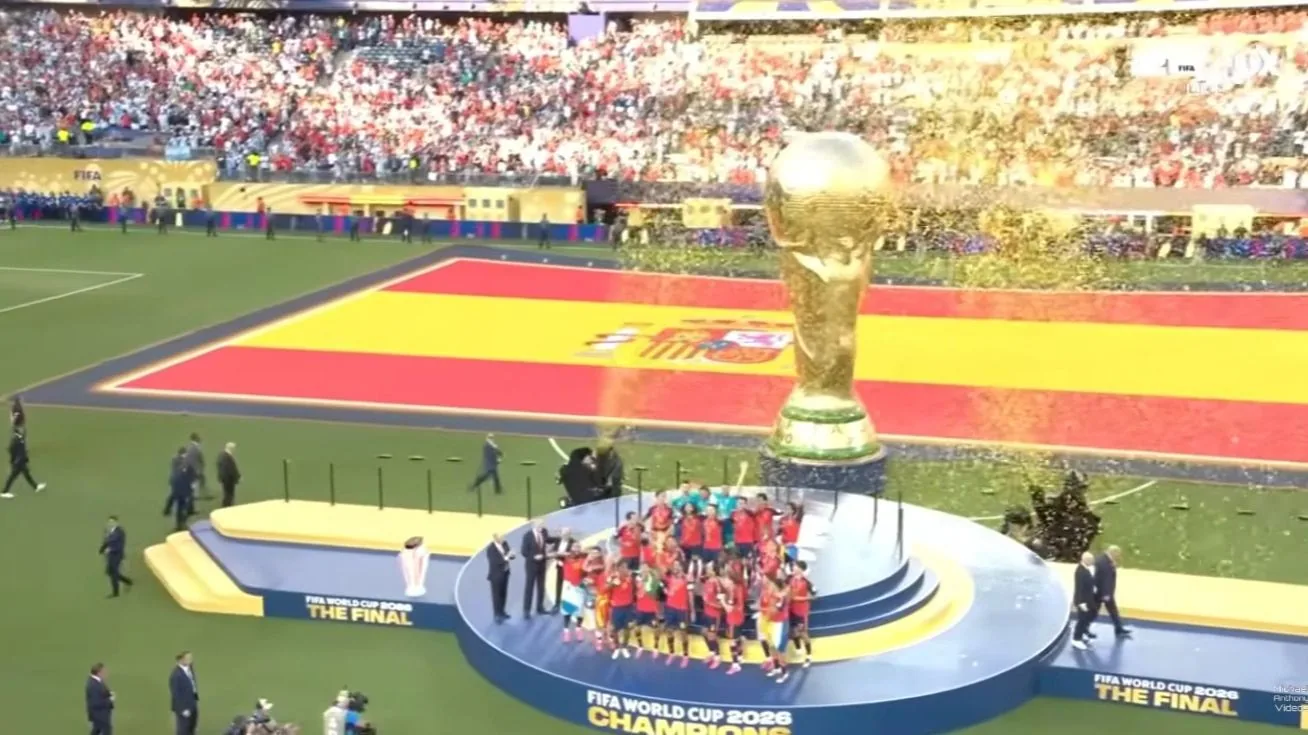
Spain beat Argentina 1-0 after extra time in the 2026 FIFA World Cup final

FifaxEditor
2026-07-24
The 106th-minute move that decided the final
On 19 July 2026, Spain beat Argentina 1-0 after 120 minutes at New York New Jersey Stadium. The winning sequence began with Spain recovering their attacking shape rather than forcing an early shot. Pedro Porro delivered from the right, Nico Williams attacked the far-post space and headed the ball back across the six-yard area, and substitute Ferran Torres finished first time in the 106th minute. The goal rewarded the movement of three players in different lanes: Porro supplied width, Williams arrived beyond the last defender, and Torres occupied the central finishing zone. Emiliano Martinez had repeatedly protected Argentina before that moment, but the speed of the final pass and finish left him with almost no recovery time. Torres had started the final on the bench, making the decisive contribution another example of Spain finding an answer through their squad rather than relying on a single fixed attacking combination.
Spain won through control and defence
FIFA recorded 20 Spanish attempts to Argentina's two across the final, while Argentina did not register a shot on target. The numbers describe sustained territorial pressure, but Spain's control was not simply a matter of keeping the ball. Their midfield continually offered safe passing angles, the full-backs held positions that stretched Argentina's defensive block, and the nearest players reacted quickly whenever possession changed. That counter-pressure prevented Argentina from turning recoveries into clean attacks and allowed Spain to begin another phase without retreating into a passive shape. Argentina still defended the penalty area with discipline, and Martinez's saves kept the score level through 90 minutes. Spain therefore had to balance patience with urgency: circulate too slowly and Argentina could reset; commit too many players too early and a transition might decide the final. Their eventual success came from maintaining that balance for longer than their opponent.
What the result means
Argentina missed the opportunity to retain the trophy, while Spain became men's world champions for the second time after their 2010 triumph. The achievement was built over eight matches and cannot be reduced to the extra-time winner alone. Spain conceded only one goal during the tournament, showed that they could dominate open matches as well as survive long scoreless periods, and received decisive contributions from different members of the squad. The final also reinforced the value of tournament management. Knockout football rarely gives a team the same problem twice: one opponent may defend deep, another may press high, and a final can demand concentration for 120 minutes. Spain adapted without abandoning their core structure. For Argentina, the narrow defeat should be separated from the balance of play; their resistance and goalkeeping kept them within one action of penalties, but they created too little to place sustained pressure on Spain's defence.
How the final changed after 90 minutes
Spain produced the clearer chances from the opening minutes. Lamine Yamal, Pau Cubarsi, Pedri and Nico Williams all tested Emiliano Martinez, while Argentina reached extra time without a shot on target. Enzo Fernandez was dismissed for a second yellow card at the end of normal time, changing the numerical balance just as fatigue began to influence spacing and recovery runs. Argentina responded by protecting the centre and asking their remaining attackers to cover more ground, while Spain widened the pitch and continued moving the ball from side to side rather than immediately forcing a crowded central pass. Martinez saved again from Williams, Mikel Merino went close and both teams had goals ruled out. The winning move eventually came from the same patient principle Spain had followed throughout the match: create width, attack the far side and place a fresh finisher in the central area.
The historical context of Spain's second title
This was the first World Cup final between Spain and Argentina and only their second meeting at the tournament after Argentina's 2-1 group-stage win in 1966. Spain's victory placed them alongside France and Uruguay on two men's world titles, sixteen years after the 2010 team lifted the country's first trophy. The two championship sides were not identical in personnel or tactical detail, but both were associated with control, technical security and the ability to manage the emotional pressure of a final. The 2026 success also created a wider national-team milestone: following the women's triumph in 2023, Spain became the first country to hold the reigning men's and women's World Cup titles at the same time. That context does not change the result of one match, but it explains why the victory sits within a broader period of Spanish international success rather than as an isolated final.
Sources
This independent article is based on FIFA's official coverage. Image rights remain with their respective owners; verify permission and attribution before reuse.