Why Rodri won the 2026 World Cup Golden Ball
FifaxEditor
2026-07-24
His value went beyond goals and assists
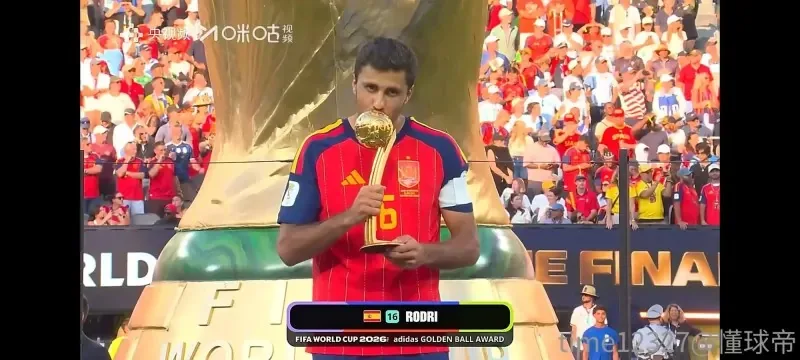
Rodri connected defence with attack, offered a reliable outlet under pressure and protected the centre when Spain committed players forward. Those responsibilities rarely create a simple highlight, yet they determine whether possession has purpose and whether the team remains secure after losing the ball. He constantly adjusted his position to remain visible to the centre-backs, receive on an angle and move play away from pressure. When the forward pass was unavailable, he recycled possession without turning the phase into harmless circulation; when a lane opened, he accelerated the attack with a direct ball into midfield or toward the wings. His defensive positioning was equally important. By occupying the space in front of the back line and reading second balls, Rodri reduced the number of clean transitions Spain had to defend. The Golden Ball case therefore rests on control, continuity and decision-making rather than a large total of goals or assists.
The midfielder behind Spain's control
Spain conceded only once in eight matches, and Rodri's work in midfield helped connect that defensive record with the team's possession game. In the final, FIFA recorded him completing 101 of 105 passes, winning 80 per cent of his duels and creating two chances. The pass total shows how frequently teammates trusted him to organise the next phase; the accuracy shows that the volume did not come with careless losses. Duel success also matters because a holding midfielder cannot operate only as a distributor. He must compete for loose balls, delay counters and prevent opponents from running directly at the centre-backs. Spain could press with several players because Rodri protected the structure behind them, and they could slow the match because he remained calm when Argentina narrowed the centre. His influence was cumulative: each secure reception and correctly timed recovery made the following action easier for the rest of the side.
What the Golden Ball recognises
The World Cup Golden Ball recognises performance during one tournament and is separate from the annual Ballon d'Or. It is not automatically awarded to the champion's leading scorer, nor is it the same as the Golden Boot. FIFA judged Rodri the outstanding player of the 2026 competition, with Lionel Messi receiving the Silver Ball and Kylian Mbappe the Bronze Ball. The result reflects the different ways influence can appear. A forward may decide matches with finishing, while a midfielder can shape where the game is played, how quickly possession moves and how exposed the team becomes after an attack. Rodri's award should therefore be read as recognition of an eight-match body of work rather than a verdict based only on the final. It also does not settle comparisons across entire careers; tournament awards measure performance within a defined competition, against a specific set of opponents and tactical problems.
The numbers behind Rodri's influence
FIFA's distribution statistics list Rodri with a tournament-leading 435 passes at 94 per cent accuracy. In the final he completed 101 of 105 passes, won 80 per cent of his duels and created two chances. The combination of volume and security is the key point. A high pass count can be misleading when it consists only of low-risk exchanges between defenders, but Rodri's role required him to receive in central areas, turn away from pressure and choose when to accelerate or calm the phase. Spain could move the ball through midfield without repeatedly exposing the defence when possession changed. His duel figure adds the other half of the role: after a loose ball or broken attack, he was expected to compete immediately and restore Spain's territorial control. Taken together, the statistics support the tactical observation rather than replacing it.
Where the award sits in World Cup history
The Golden, Silver and Bronze Balls have been awarded since 1978. The winners list includes attackers such as Diego Maradona, Ronaldo and Lionel Messi, but also goalkeeper Oliver Kahn and midfield organisers Luka Modric and Rodri. That range shows why the Golden Ball is not a scoring award. It recognises the player judged to have produced the strongest overall tournament, whether the decisive influence comes through finishing, chance creation, goalkeeping or control of the match. The award should still be interpreted within its limits. It covers one World Cup, not an entire season or career, and the tactical role of each candidate can be very different. Rodri's selection therefore says that his influence on Spain's eight-match campaign was considered the most complete; it does not turn unlike-for-like positions into a permanent historical ranking.
Sources
This independent article is based on FIFA's official coverage. Image rights remain with their respective owners; verify permission and attribution before reuse.